Monday, April 9, 2012

From the Ardeche to the Aveyron

    On Friday, April 6, our last full day in the Ardeche, we went to the weekly market in Ruoms, then stopped at the Vignerons Ardechois tasting room to try some of their rosés. We had planned to taste some wines after our tour the previous day, but the whirlwind tour ended at noon, and the tasting room was closing. So today we tried several rosés and one white wine, clearly in the wrong order since the pourer chastised us for starting with fruitier rosés then progressing to drier ones, and also committing the cardinal sin of trying the white wine after the rosés. But we did find a rosé that we thought was exceptional, the fruity 2011 Cuvée Oréile, a blend of mostly Grenache and Gamay with a little Syrah, and we bought 6 bottles of it.

        After lunch at our gite, we drove to the city of Montelimar, across the Rhone in the Drome department. Montelimar is known for the production of nougat candy (there are dozens of nougat shops throughout the city), and for its medieval chateau, Chateau Adhemar, perched high above the city. We walked through the old part of Montelimar, then made our way up to the chateau for a visit. The chateau was quite interesting and had very good views of the city below, but after leaving the chateau we felt that the 2 hours we had spent walking around Montelimar was sufficient, so we decided to depart.


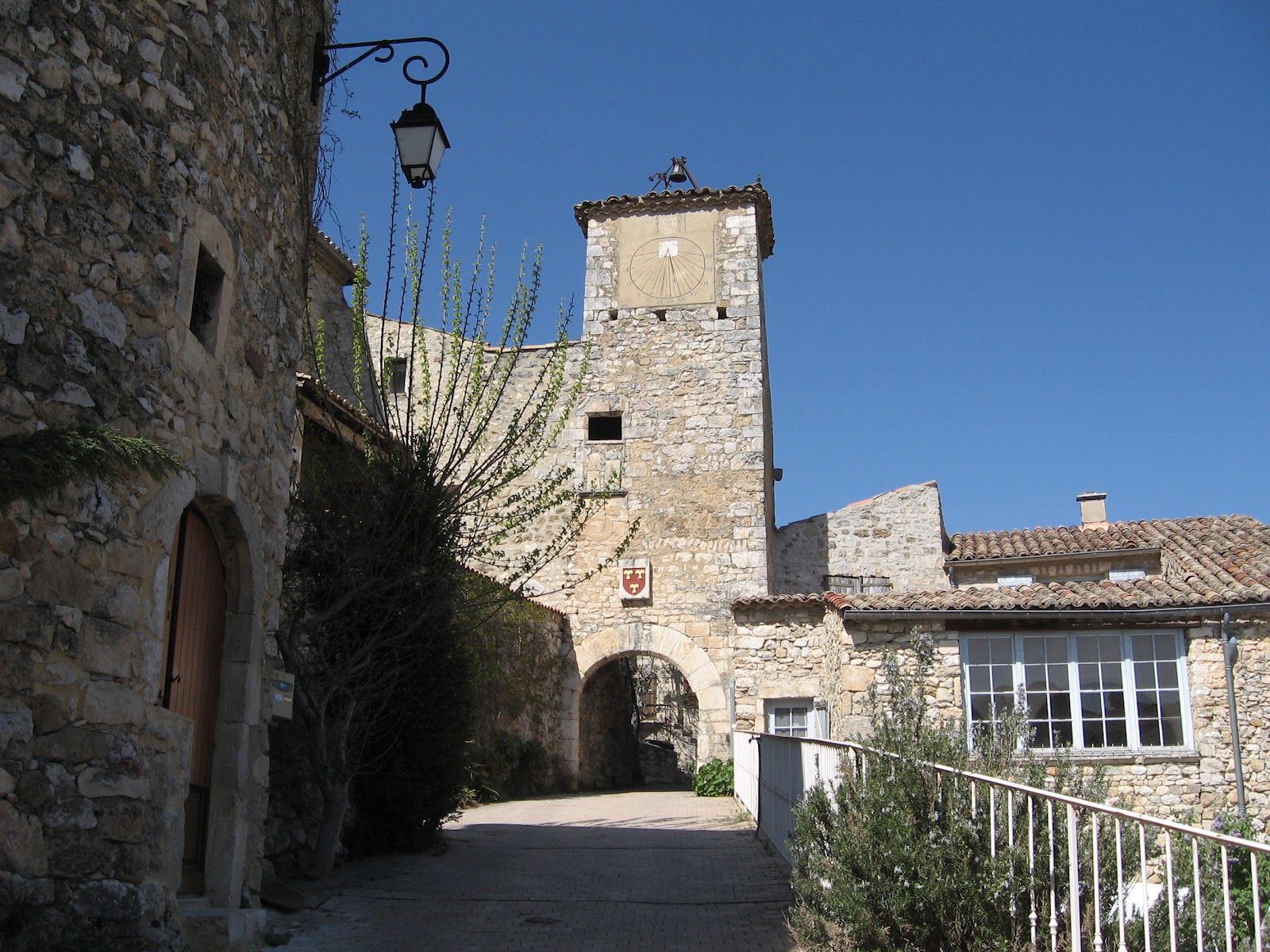
We headed back from Montelimar by going south rather than taking the direct route through the dreary, traffic-clogged town of Le Teil. It was beautiful countryside once we left Montelimar, and we passed by several charming villages, including Valvignieres, where we stopped to stroll through the town. It was a beautiful village, with lots of interesting old buildings, and two very friendly cats.

      There were also plenty of signs protesting against “Gaz de Schiste,” which apparently is the process of extracting natural gas from shale (schiste), or, as it's known in the US, “fracking.” We saw these signs all over the southern Ardeche, and the gite owner, Patrice, told us a little about the current controversy in the region. He was quite familiar with the issue, as his cousin is a geologist with a major French oil and gas company, and has visited the US to study our “fracking” industry.
 On Saturday morning we left our gite in the Ardeche to drive to the Aveyron, our next stop. On the way out we stopped at the Vignerons Ardechois tasting/sales room to buy a bottle of their 2011 Vendange d'Octobre (October Harvest), which was being released that day. It's a late harvest sweet Viognier, and would be called a Vendange Tardive except that French law now only allows Alsace to use that term, so other regions have come up with different terms for late harvest wines (and we tried the wine a few days later, and it was spectacular).

     It was about a 4 hour drive from the Ardeche to the Aveyron, mostly on smaller roads and much of it through the mountains. It was quite spectacular despite the fact that it rained a fair amount of the trip, and we passed through dozens of small towns and villages. There were also several chateaus and chateau ruins on the route, including one, Chateau de Champ, that offered spectacular views from the road.


      We arrived at our gite in Belcastel mid-afternoon. The gite was fabulous and spacious, and has amazing views of the village and the Aveyron River. Belcastel is classified as a Plus Beaux Villages (Most Beautiful Villages) of France, and in this case that's not an overstatement. When the weather clears I'm hoping to take a bunch of pictures of the village, but here are some from the terrace of our gite.

Friday, April 6, 2012

Lazy Days in the Southern Ardeche


            Having been to the southern Ardeche twice in the prior 3 years, we didn't feel the need to visit every single village again, so our days were a little lazy. On Wednesday morning, April 4, we went to the town of Joyeuse, which has a very lively outdoor market, and we bought more fromage de chevre, as well as saucisson from a local producer who was giving out samples of his salamis and cheeses.  And since asparagus season is underway in this part of France, we bought a bunch to have with dinner.

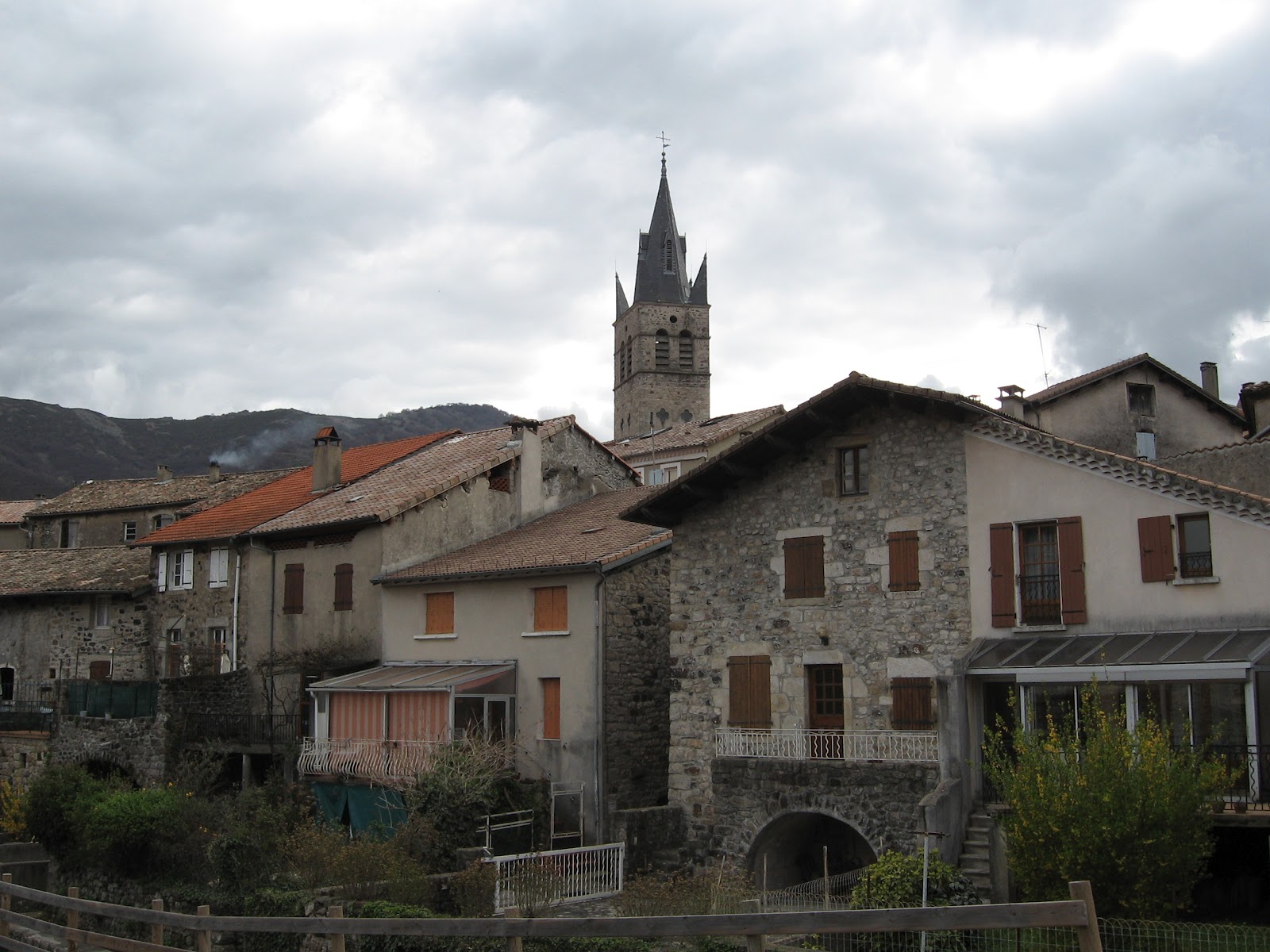
            Like so many towns in France, Joyeuse has a church spire high above the center of town.  Also like so many towns, the main road runs right through the center of town where most of the shops are located, but in Joyeuse there is also a quiet center with a few shops and some museums, and we took a walk through that part of the town.


            The next day, Patrice Reverger, the owner of the gite we were staying at and a grape grower who sells his grapes to the local cooperative, arranged a tour of his cooperative in the morning.  Actually, he arranged tours of two different parts of the cooperative.  First of all, we went with him to the local branch of the cooperative, called the Vignerons Sud Ardeche, in the nearby town of Ruoms.  We met the Director of the cooperative, and then Patrice gave us a tour of the facility.  All of the growers who sell their grapes to the Ruoms cooperative bring their grapes there, where they are crushed and vinified and then bottled. There is a small tasting room, where wines are also sold.

            We then went to the facility of the large umbrella organization, the Vignerons Ardechois, or UVICA, housed in a large modern facility on the outskirts of Ruoms.  UVICA is the result of the agglomeration of 21 cooperatives in the Southern Ardeche.  No wine is vinified there, but juice is apparently trucked in from all of the cooperatives and filtered and bottled there, much of it in bulk, but also a good deal of it in bottles.  The Director of Production gave us a whirlwind tour of the facility, which was incredibly mechanized with a huge production.  Despite Patrice's explanation, I was never able to quite figure out the exact relationship between the Vignerons Ardechois and the Vignerons Sud Ardeche (and indeed the other cooperatives that made up UVICA).

            That afternoon we drove into the mountainous part of the southern Ardeche and stopped in the villages of Meyras and Thueyts.  I went to the little all-purpose shop in Meyras to get a “Meyras – Village Medieval” T-shirt to replace the one I had bought there 2 years ago, and we stumbled upon 3 curious cats.


            In Thueyts we ran across a friendly white cat, and walked to the edge of town to get a view of the Pont Diable (Devil's Bridge) in the valley below.
  
THUEYTS


            At the end of the day we returned to Domaine Jerome Mazel to pick up some more of his wine.

Wednesday, April 4, 2012

The Southern Ardeche: Chateaus, Churches, Chevre, and Chatus


      On our second full day in the Ardeche, Monday April 2, there were no outdoor markets, so we decided to just drive to a couple of villages in the morning to do some sightseeing.  We started in Banne, a small village in the Cevenne hills about ½ hour from where we were staying.  We walked up to the top of the ruins of the old chateau, from where you can see the center of the village and the church that dominates the town.


             We then drove to Les Vans, a much larger town that is the regional center of this part of the southern Ardeche, and strolled around and bought some bread and pastries from two of the many bakeries in town.  We then made our way back to our gite for lunch.


            In the afternoon we took a drive to Rochecolombe, a village not far from our gite which has a medieval part that had been a ruin but has been restored over the years, and walked through that part of the town.


             At the end of the day we visited Domaine Jerome Mazel, a wine producer that we had spent a lot of time at 2 years before and wrote several posts about.  As we approached the winery Jerome's mother was walking by and recognized us, and opened the caveau and gave us a tasting of the entire range of wines (Jerome was out in the fields replanting a vineyard).  As was the case on our last visit, the wines were simply outstanding, especially the 2 Viogniers (both the dry version and a late harvest) and the all-Syrah Magie Noire (Black Magic).  She also poured us a wine Jerome called Nature, made from the banned Jacquez grape variety, a phyloxerra-era American grape.  We bought a bottle of the 2011 rosé and one bottle each of the 2 Viogniers.


       The next morning was market day in Largentiere, which has a chateau overlooking the lower part of the town, and we spent a couple of hours strolling through the market and the old part of town. We bought another Provencal cloth from a vendor at the market, a couple more fromages de chevre, and a few other culinary provisions, including olive oil from a local producer. With lunch we had the 2010 Pouilly-Fuissé we had bought in Vinzelles.
Largentiere

            In the late afternoon we drove to the town of Rosieres to visit two producers of Chatus wines that we had stopped at on prior trips to the region: the Cave Cooperative La Cevenole, and Domaine de Grangeon.  Three years ago we had first visited this part of the Ardeche after reading Robert Camuto's book Corkscrewed, which included a chapter on the obscure Chatus grape.  Chatus wines are made by fewer than 10 producers in the foothills of the Cevennes mountains in the Ardeche (the Cevennes Ardechois region), and apparently nowhere else in the world.  Wines made from Chatus are quite tannic, must be aged in oak for at least 12 months (Domaine de Grangeon's is aged for 2 years), and need several years to be ready to drink.  We bought bottles of Chatus from the 2008 and 2009 vintages from both La Cevenole and Domaine de Grangeon, and a bottle of 2011 rose from La Cevenole.


Monday, April 2, 2012

Onward from Annecy

          After leaving Annecy we took a bus to the Geneva airport to pick up our car, and then we drove towards the Beaujolais region, where we were to spend that night. We took back roads rather than the highways so that we could pass through some villages and get a better look at the countryside. And on the way we stopped at a wine cooperative, Cave des Grand Crus Blancs, in Vinzelles, just south of Macon, which we had visited a few years ago with a French friend. The cooperative produces an array of wines from the region covering numerous appellations, such as Macon-Loché, Pouilly-Vinzelles, Pouilly-Fuissé,and several other confusingly-hyphenated appellations. We bought a number of wines, including a sparkling Cremant de Bourgogne, then continued our route towards Beaujolais. On the way we passed up a chance to take a detour to see George Debouef's Hameau du Vin in Romanche Thorins, a sort of Disney version of a wine village.

    We arrived at our chambre d'hotes (bed and breakfast) in the late afternoon,which was just outside the village of Oingt, classified as a Plus Beau Village (Most Beatiful Village) of France. The bed and breakfast was at a winery, Domaine Guillard, and the owner/winemaker, Roger Guillard, gave us a tasting of his wines in the caveau.

    Monsieur Guillard makes several red, white and rose versions of Beaujolais, and his wines are entitled to simply a Beaujolais appellation, as the domaine is not located in any of the cru or Villages appellations. But that didn't keep his wines from being excellent, the reds having a pure taste of the Gamay grape, and we bought a couple of different cuvées. One of them was Cuvée Centenaire, celebrating the fact that the domaine had just celebrated its 100th anniversary. It was founded in 1911 by Roger's grandfather, and Roger is the third, and perhaps last, generation of family winemakers, as his 2 sons show no interest in winemaking at the moment.

.
.   That evening we walked to Oingt and spent awhile strolling around the village, then had dinner at Le Vieux Auberge in the center of town. I had chicken with mushrooms and a cream sauce and Ann had an entrecote de boeuf. We ordered a local Beaujolais, from an organic producer, Domaine Chasselay, which was quite a surprising wine. Although it was a Beaujolais, it didn't taste anything like a Gamay, but instead, if anything, it resembled a California Cabernet. It was very good, but definitely not what I had expected. At our tasting earlier that evening Roger Guillard had talked about how he made his wines with respect for tradition and terroir, and I felt that this wine was so different from what the types of wine he was trying make. But maybe I'm out of step with the modern wine world.

Oingt

    
    The next morning, after having breakfast at Chez Guillard, we headed off to the southern Ardeche, where we were going to spend a week in Pradons at the same gite we had rented 2 years ago. On the way we stopped at Cave de Sarras, a producer of St. Joseph wines that we had bought many wines from 3 years ago when we stayed nearby. Two years ago we planned to stop there on our way to the Jura, but as we pulled into their parking lot at 1 minute before noon, the gate came down for lunch, and we missed out. So this time we left plenty of time to get there, and were not disappointed. After hauling away a half case of St. Joseph and Condrieu wines, we continued on our way, making a few stops to see some hilltop villages.


   We arrived at our gite in the later afternoon after stopping to pick up some provisions in Ruoms, then opened a bottle of Cremant de Bourgogne and sat outside on the terrace enjoying the view. Just before dinner, the gite owner, Patrice Reverger, stopped by to give us a couple of bottles of wine from Domaine des Terriers, whose winemaker is a friend of his. It was a warm day and a very mild evening, so we sat outside and had dinner on the terrace, accompanied by a bottle of Monsieur Guillard's 2009 Beaujolais.

    The next day, April 1, we drove to the small town of Lablachere, where a weekly outdoor market was being held. Among other things, we picked up a spit-roasted duck with roasted potatoes from a market vendor, and some Provencal tablecloths. We then drove back to the gite where we had the duck for lunch, with a bottle of 2010 Macon-Vinzelle.
    In the afternoon we took a drive to the hillside village of Lagorce, where we walked around the town and then hiked along a path through the woods. After returning to our gite we sat out on the terrace and had some olives, tapenade and rosé from Domaine des Terriers. That night our dinner consisted of a salad, an array of goat cheeses we had picked up during our trip, and a bottle of 2010 Pouilly-Loché.


Thursday, March 29, 2012

First Stop -- Annecy

      As on our last trip to France, we started off in Annecy, and stayed at Hotel de Savoie, the same place as we ended our last trip. We also had a room with the same view – the canal, and the old part of the city with the chateau looming above it.


     It was a spectacular day with clear blue sky, and we spent most of the afternoon and early evening wandering around the city. There were hundreds of people out walking along Lake Annecy and enjoying the open green spaces all around the lower part of the lake. And flowers were planted everywhere.

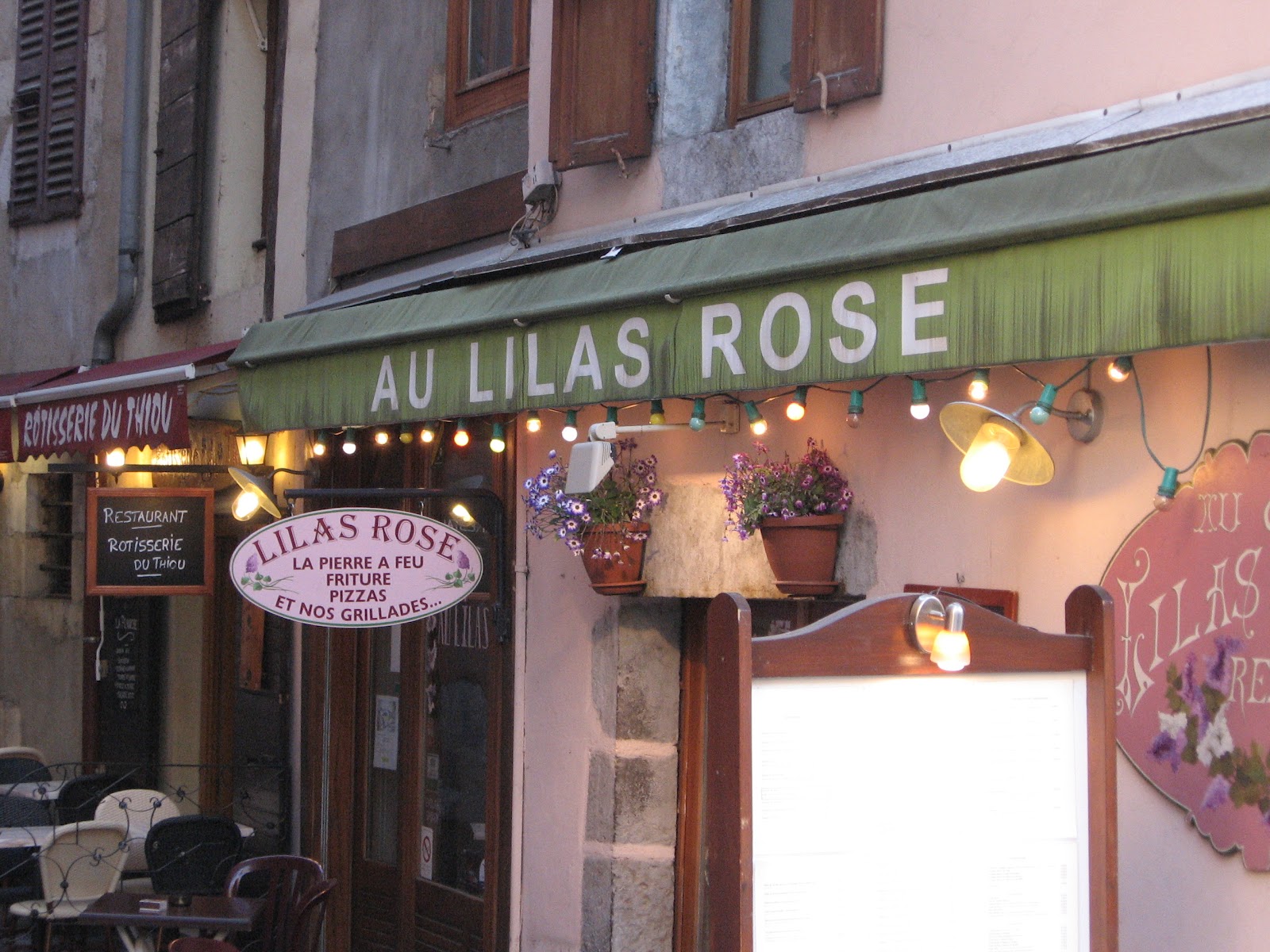
    We had dinner the first night at Lilas Rose, the same restaurant we had eaten at every evening on our last trip. While the restaurant had slipped somewhat since last time, the selection of Savoie wines was still excellent, and we had two outstanding wines – a Mondeuse, and a Chignin-Bergeron from Andre et Michel Quenard, one of the top Savoie producers. After dinner we went to check out our favorite ice cream place, Glacier des Alpes, which I had written about last time, but alas it had closed early. Not surprising since it was still March, and mid-week. We then returned to our hotel and went to bed early, since we hadn't slept in about 36 hours.
    We slept well, and the next morning took a bus to Menthon, a town about 5 miles from Annecy. We walked through the town and into the hills towards the chateau.

Chateau de Menthon
          We then walked down to the lake and had a picnic with cheese we had brought that morning from Fromagerie Pierre Gay, where we had made many stops on our prior visits. Last year Pierre was named a Meilleur Ouvrier de France (literally Master Worker of France) in the Fromager category, a very prestigious award that comes after a series of competitions. His shop is one of the finest cheese shops anywhere.

    We then walked back from Menthon to Annecy, stopping briefly in the town of Veyrier du Lac, where Mark Veyrat has his 3-star Michelin restaurant. As we were walking, we saw Monsieur Veyrat driving by on his way out of town, maybe to pick up some cheese from Pierre Gay in Annecy.  When we reached Annecy in the mid-afternoon, we stopped at Glacier des Alpes and had some ice cream.  It was as good as we remembered. 
     Tomorrow we leave Annecy to pick up our car in Geneva, then head to the Beaujolais region for a day on our way to the Southern Ardeche.  More to come ...

Monday, November 21, 2011

A SHORT EXCURSION TO QUEBEC CITY

    No trip to France for us this year, so we decided to take a short trip to the closest thing to France in North America – Quebec City.  So, after  a 5 ½ hour drive through some beautiful northern Maine scenery, we arrived in Quebec City to be greeted by signs in French and the French language being spoken everywhere.

  We stayed at a B&B – Aux 3 Balcons  – which was in a great area that was well outside the usual tourist route but was still within walking distance of everything we wanted to see.  For anyone going to Quebec I’d definitely recommend Aux 3 Balcons.  The rooms are wonderful, the ambience is fantastic, the place is on a very quiet street yet is convenient to everything, and the proprietor, Isabelle Ouellet, is a former tour guide who provided us with a wealth of information as well as 2 fantastic breakfasts.

    After checking in to our B&B, we spent the afternoon wandering around our neighborhood and then walking towards the walled part of the city.  Quebec City is quite lively, with people walking everywhere and loads of bakeries, restaurants, bookstores and small grocery shops (epiceries).
Chateau Frontenac Viewed From the Parliament Hill


    In the late afternoon we stopped into Le Moine Echanson, a wine bar/restaurant that had recently been featured in a NY Times article about Quebec City.  Each season, the restaurant features the wines of a couple of different French regions with food representing those same regions.  This fall, the Auvergne and the Loire are the stars, with a little of Burgundy thrown in.  We wound up having a couple of glasses of wine, then stayed for dinner.  The emphasis is on so-called “natural” wines, generally made by producers following organic or biodynamic principles. Many of the restaurant's wines are Vin de Table or Vin de France rather than AOC wines, being produced by vignerons who prefer to work outside the appellation system, either because they're making wines with old varieties of grapes not approved for their AOC, or because their wines include a higher percentage of certain grape varieties than the AOC rules allow, or, as in the case of Olivier Cousin, because they've decided to thumb their noses at the French wine authorities and refuse to submit their wines for AOC approval.  We tried a number of wines from Olivier Cousin, whose recent troubles with the French wine authorities has been written up in a number of wine blogs recently, and they were all fascinating and tasty, including a red and a rose made from the little-known Grolleau grape variety.  We also had a couple of Loire whites made from the equally obscure Pineau Meunier grape.  One great thing about Le Moine Echanson is that all of their wines are available by either the glass or bottle, and the knowledgeable staff will let you try any wine before pouring you a glass.  All in all, the meal was great, the wines were great, and the restaurant was a fantastic experience.


    The next day, our only full day in Quebec City, we spent most of the time walking all over the city.  We started in the old walled sector, then walked down to the lower part of the city.  We wandered around admiring the old buildings, then walked along the St. Lawrence river and the port area.
Chateau Frontenac from the lower city


City walls
   
Lower city

        Eventually we wound up at the Marché de Vieux Port, or Market of the Old Port, which is a food hall with farmers and other local producers selling their wares.  There was a great cheese stall selling dozens of different Quebec cheeses, and we would up buying two cow cheeses and one goat cheese.


    We then walked up from the Old Port to the St. Roch district.  When we were last in Quebec City, about 20 years ago, this was apparently a pretty decrepit part of town, but it's been revitalized, and was definitely worth spending some time walking through. We found a terrific bakery – La Boite à Pain – that supplies the bread for Le Moine Echanson , and we bought a baguette to have with the cheese and foie gras we had bought at the market.  We then headed back to Aux 3 Balcons, which required a strenuous climb up a series of stairways then up another hill.  For lunch we just hung around the B&B, opened a bottle of wine (a really good red Corbieres) that we bought at the local SAQ (Societe Alcohol de Quebec) outlet, and had bread and cheese with the wine.
Inside the walled city

Fresco in the lower city


    After lunch we went to the Musee de Beaux Arts to see the Caillebotte exhibit  – Gustave Caillebotte the painter and his brother Martial, the photographer.  We spent an hour or two at the museum, then took a walk through the park in which the museum is located, and eventually made our way back to our B&B in the early evening.  We took another walk in the evening, first having a very forgettable dinner at a forgettable restaurant and then wandering around a bit.  We stopped at a chocolate shop that had a fascinating Musee de Chocolate attached to it, then eventually returned to our room where we had the foie gras from the afternoon with a glass of sweet late harvest Jurancon wine.

    On Saturday we checked out of the B&B and drove to the Cote de Beaupré, or Beaupré coast, which runs east from Quebec City along the north side of the St. Lawrence River.  We drove part of La Route de Nouvelle France, and stopped at the park at Montmorency Falls, a massive waterfall where the Montmorency River drops down before emptying into the St. Lawrence.  There's a long walkway heading up towards the falls that give you great views of the massive wall of water, and a walking bridge at the top of the falls.
Montmorency Falls


    After seeing the Montmorency falls we crossed the bridge to the Ile d'Orleans, a small island where we were spending the night at Auberge L’Ile Flotante, a B&B on the south side of the island.  Ile d'Orleans is principally an agricultural area, although with its proximity to Quebec City (about a 15 minute drive) it's been developed quite a bit since we were there 20 years ago.  However, it’s still principally a farming area, growing about 80% of the potatoes sold in this part of Quebec, as well as a host of other produce.  There are also a few wineries there, including Cassis Monna & Filles, which produces cassis in various forms from black currants grown on the property.  We were told that the Ile d'Orleans was originally named Ile de Bacchus by the explorers, who noticed all the wild grapes growing there, and in fact there's a winery named Vignoble Ile de Bacchus that makes a fantastic ice wine (Vin de Glace) from Vidal grapes.  We stopped at both Cassis Monna et Filles and Vignoble Ile de Bacchus to taste their offerings, and we came away with a bottle of cassis liquor, a cassis aperitif wine, and a bottle of Vin de Glace.


    After the two winery visits we drove around the perimeter of the island, stopping at a tower at one end of the island which, once we climbed to the top, gave a great view of the Cote de Beaupré and the mountains beyond it.  We then continued around the island and stopped at the Auberge L’Ile Flottante to check in.  The Auberge is run by Tony, a former banker, and Genevieve, who used to work in customer relations at Sears Canada.  The place is quite wonderful, Tony and Genevieve are incredibly friendly and warm, and the breakfasts they serve are fantastic.
Ile d'Orleans farm with Cote de Beaupre in the distance

Church in St.-Laurent-de-Ile-d'Orleans


    Saturday evening we had reserved dinner at the Auberge au Gout d’Autrefois, a restaurant and farm that raises ducks, geese, guinea fowl and pheasants, as well as organic vegetables.  The farm and restaurant are both run entirely by Jacques Legros – a former Green Party candidate in the Canadian federal elections – and his partner.  The meals served at the restaurant are principally from the products raised at the farm, as well as from a few other producers on the island.  The vegetables are all raised organically, the animals are raised humanely and in the open air and with no antibiotics or growth hormones used, and all work on the farm is done by hand with mechanical instruments.  Our dinner, which consisted of a 12-course set menu, featured fare from all of the various animals raised on the farm, including smoked goose breast, smoked duck, rilletes of goose, duck, and wild turkey, and breasts of pheasant and guinea fowl.  The restaurant doesn’t serve wine, but it supplies wine glasses and corkscrews, and we brought two wines we had purchased in Quebec City – a Rolet Cremant de Jura Brut and a 2009 Bourgueil from Yannick Amirault – plus the Vin de Glace from Ile de Bacchus.  Dinner was an amazing experience, with Jacques explaining the preparation of each course and how he raises the animals, and it stretched out over almost 4 hours.  Needless to say, we slept well that night, our last night before driving home.
Salad surrounded by smoked duck breast

Dining room at Autrefois with Jacques in the background


    On Sunday we left Ile d’Orleans, drove through Quebec City and south across the bridge out of the city, then headed west along the St. Lawrence to try to find a couple of cheese producers.  We spied one that we hadn’t planned to stop at (Fromagerie Bergeron), but since it was open we stopped in and bought some cheese.  However, the next producer, Jac le Chevrier, whose fantastic goat cheese we had bought at the Marche de Vieux Port, wasn’t open, and we never did find La Moutonnière, a sheep cheese producer in Sainte-Helene-de-Chester.  We then decided to head back to Maine for the long drive home, and since it got dark so early we weren’t able to see the scenery for a large part of the drive.  It was a great trip, and we plan to return soon, this time adding a separate expedition to stop at some of the fantastic Quebec cheese producers.